In a device designed by Academician Rebinder the surface tension is determined from the pressure difference required to form a bubble of air at the end of a capillary immersed in the liquid being investigated (Fig.) .
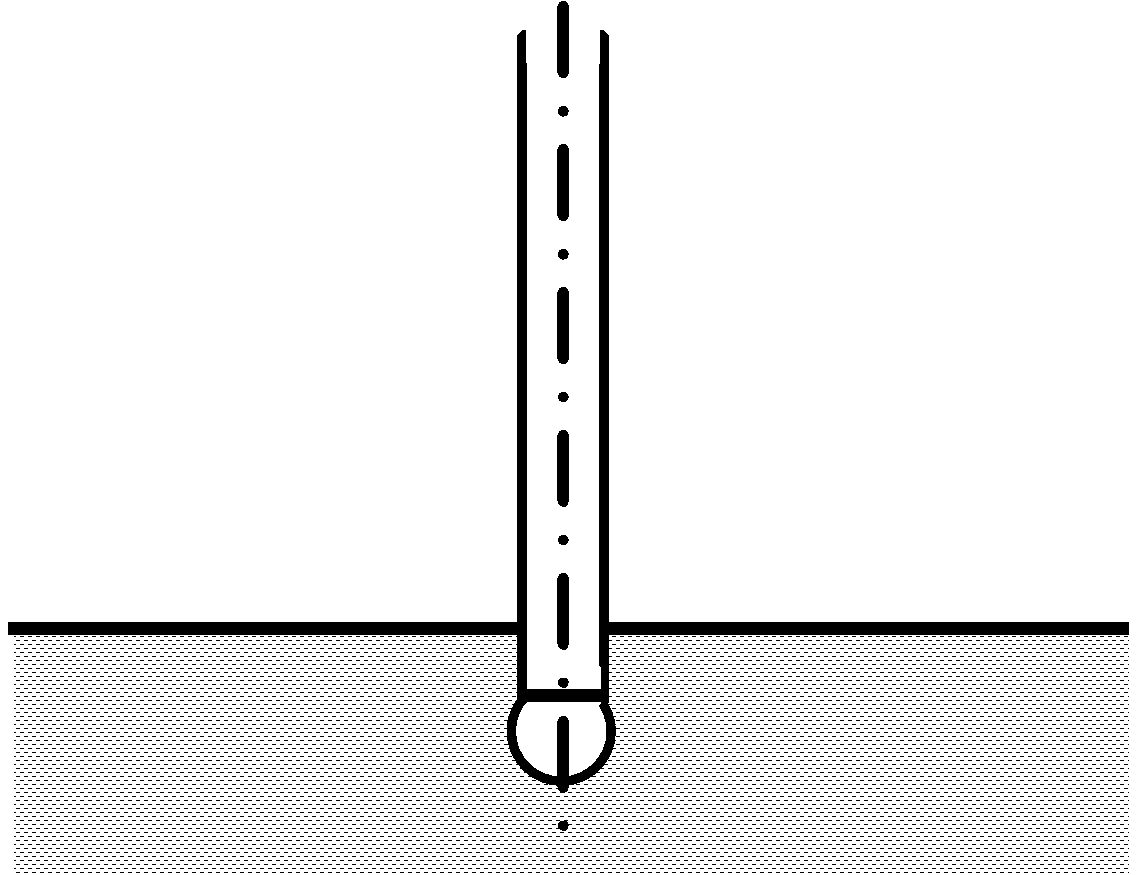
Calculate the surface tension if the radius of the capillary is r = 1 mm and the difference in the pressures during bubble formation is  P = 14 mm of water column. The end of the capillary is near the surface of the liquid.
Text Solution
Verified by ExpertsCHECK THE SOLUTION.
Sol. The additional pressure produced in the bubbles of air inside the liquid by surface tension can be found from the following simple reasoning.
When the end of the capillary touches the surface of the liquid the latter will rise in the capillary to a height h =  under the action of a surface tension F = 2 π r α directed upwards. In this case the force F is equalized by the weight of the liquid column. If an additional pressure
Δ P =  =
=  =
= 
Is set up in the capillary above the surface of the liquid (S = π r 2 is the cross-sectional area of the capillary) the action of surface tension will be completely balanced by the excess pressure of the air in the capillary while the weight of the liquid column in the capillary will remain unequalized. Therefore, the level of the liquid in the capillary should go down to the initial height and a bubble of air—a hemisphere of radius R equal to the radius of the capillary r—will form at the end of the tube. The required pressure in the bubble will be
Δ P = 
Where R is the radius of the bubble.
It can be shown that this expression always determines the excess pressure built up by the surface tension in closed bubbles inside a liquid.
Formula (1) shows that the pressure in the bubble diminishes as the radius of the bubble increases. The formation of a bubble at the end of the capillary proves that the minimum radius of the bubble is equal to the radius of the capillary.
Therefore, when α is calculated from the data in the problem the radius of the capillary should be inserted, instead of R, in the calculation formula
α = 
 70 dyn/cm.
Prepare Smarter with CGP Edu
Get practice questions, solutions, and test series in one place.
Write a Review
Share your experience with this question and solution.
Commentary
Send your comment, doubt, correction, or feedback to admin.
Similar Questions
Explore conceptually related problems